Traditional Moroccan Music: A Comprehensive Guide to Gnawa, Andalusian & Folk Sounds
Explore the rich tapestry of traditional Moroccan music — from the trance-inducing rhythms of Gnawa and the refined poetry of Andalusian orchestras to the communal folk dances of the Atlas Mountains. This guide covers instruments, cultural heritage, and how to experience it all firsthand.
Close your eyes and imagine the sound: a deep, buzzing guembri anchoring a hypnotic beat while metallic qraqeb click in polyrhythmic waves, and voices rise in call-and-response chants that have echoed across Morocco for centuries. Traditional Moroccan music is not background noise — it is the living pulse of a nation shaped by Amazigh, Arab, African, and Andalusian civilizations converging at a geographic crossroads unlike anywhere else on earth.
Whether you’re planning a trip or simply curious about one of the world’s richest musical traditions, this guide walks you through every major Moroccan music style, the instruments that define them, and exactly where and how to experience these sounds — from dusty village squares to world-renowned festivals.
✦ Key Takeaways
Traditional Moroccan music spans diverse styles including Gnawa, Andalusian, Berber, Malhun, and Chaabi — each with unique roots.
Each style reflects Morocco’s position at the crossroads of Africa, Europe, and the Middle East.
Instruments like the oud, guembri, and bendir create Morocco’s distinctive, unmistakable sound.
Music plays a vital role in Moroccan society — from religious ceremonies and weddings to harvest celebrations.
Modern fusion artists are keeping traditions alive while creating innovative new sounds for global audiences.
What Is Traditional Moroccan Music?
“Traditional Moroccan music” is the collective term for Morocco’s indigenous and historical music forms — a constellation of styles including Aita, Amazigh folk, Andalusi classical, Gnawa, Malhun, and Chaabi. Each one carries its own sound, purpose, and place in Moroccan life, and together they form one of the most diverse musical landscapes on the planet.
The roots of this music stretch back thousands of years, with a rich history reaching into pre-Islamic times. Over the centuries, Arab, Berber, sub-Saharan African, and Andalusian influences arrived in waves — each group layering their melodies, rhythms, and poetic traditions onto Morocco’s existing musical fabric to create something endlessly evolving yet deeply rooted.
💡 Music as a living tradition: Unlike Western classical music, traditional Moroccan music is primarily transmitted orally — parents teach children, masters train apprentices, and communities gather to play together. Written notation is rare; the music lives in practice and performance.
Music serves many interlocking roles in Moroccan society:
- Spiritual practice — Central to Sufi rituals, religious ceremonies, and Gnawa healing traditions where music bridges the human and divine.
- Social bonding — Weddings, harvest festivals, and national celebrations all revolve around communal music-making.
- Storytelling and oral history — Songs preserve local legends, historical events, and cultural values across generations.
- Community identity — Each region, village, and ethnic group maintains musical traditions that define who they are.
This is not museum music. It is performed in homes, on streets, at markets, and during every major life event. When you hear traditional Moroccan music, you are hearing centuries of culture still in motion.
Overview of Moroccan Music Styles
Morocco’s musical diversity mirrors its geographic and ethnic variety — mountain villages sound different from coastal cities, Arab neighborhoods produce different melodies than Berber communities, and the country’s northern edge carries different influences than its Saharan south. Here are the major Moroccan music styles you need to know.
Andalusian Music — The Classical Tradition
Andalusian music is Morocco’s classical heritage, rooted in medieval Moorish Spain. When Muslims and Jews fled Spain during the Reconquista, they brought this refined, poetic music to Moroccan cities. Today, formal orchestras in urban centers like Fes and Tetouan keep this tradition alive, performing intricate compositions called nūbas — suites of vocal and instrumental pieces organized by musical mode.
The music features complex melodies, sophisticated rhythmic patterns, and poetic lyrics drawn from classical Arabic verse. A full nūba performance can last several hours, moving through distinct sections that shift in tempo and mood. It’s contemplative, intellectual, and deeply beautiful — the Moroccan equivalent of a European symphony tradition, but with its own entirely distinct sound world.
The best place to hear authentic Andalusian music is at the Fes Festival of World Sacred Music or at intimate concerts hosted by cultural associations in Fes and Tetouan. These events are far more rewarding than tourist-oriented dinner shows.
Gnawa Music — Spiritual Trance from Sub-Saharan Roots
Gnawa music is perhaps Morocco’s most internationally recognized style — a spiritual, trance-inducing tradition with deep African roots. Brought to Morocco by enslaved people from sub-Saharan West Africa, Gnawa combines call-and-response singing, complex polyrhythms, and repetitive melodic patterns designed to induce states of spiritual ecstasy and healing.
At the heart of Gnawa is the lila — an all-night healing ceremony led by a maalem (master musician) playing the three-stringed guembri while singers and dancers invoke spiritual entities through specific songs, colors, and incense. UNESCO recognized Gnawa culture as Intangible Cultural Heritage in 2019, cementing its importance to world culture.
Chaabi — The People’s Music
Chaabi — meaning “of the people” — is Morocco’s most popular urban folk style. It blends elements from various regional traditions into something fun, accessible, and irresistibly danceable. You’ll hear it at virtually every celebration: weddings, birthdays, national holidays, and street festivals across Morocco’s cities.
The music features lively rhythms, simple but catchy melodies, and lyrics that mix humor, love, and social commentary. Unlike the formal training required for Andalusian music, Chaabi thrives on energy and audience connection. Musicians respond to the crowd, improvise, and keep the party going — making every performance unique.
Amazigh (Berber) Music — Voices of the Mountains
The indigenous Amazigh people have maintained distinct musical traditions for millennia across the Atlas Mountains, the Rif, the Souss Valley, and the Saharan edges. Each Berber group — Tashelhit, Tamazight, Tarifit — has its own musical dialect, but common threads include group singing, communal dancing, improvised chanting, and the central role of percussion.
Berber music is fundamentally communal. Performances like Ahwash (in the High Atlas) and Ahidous (in the Middle Atlas) involve entire villages — men and women forming circles or lines, singing and swaying in synchronized rhythmic patterns that can continue for hours. The music marks harvests, weddings, seasonal changes, and religious occasions in Morocco’s unique mountain villages.
Malhun — Urban Sung Poetry
Malhun is a sophisticated style of sung poetry that flourished in Morocco’s imperial cities — Fes, Meknes, Marrakech, and Salé. Male ensembles perform complex compositions that blend classical Arabic poetry with melodic accompaniment. The lyrics address themes of love, spirituality, social values, and historical events, requiring both deep literary knowledge and musical skill from performers.
Raï — Modern Voices from the North
Raï arrived from Algeria and found a passionate audience in northern Morocco, especially among younger listeners. It’s socially conscious, emotionally direct, and blends traditional vocal styles with modern instruments like electric guitars and synthesizers. Raï speaks to contemporary experiences — love, poverty, emigration, and social frustration — giving voice to issues that classical traditions rarely address.
💡 Why so many styles? Morocco’s musical diversity maps directly onto its geography, history, and ethnic composition. Mountain villages, coastal cities, imperial capitals, and desert oases each developed distinct sounds — shaped by isolation, migration, trade, and the specific cultures that called each place home.
Moroccan Folk Music
While the styles above can be categorized by origin and formality, Moroccan folk music is the broader category of music that belongs to rural communities — performed at local festivals, weddings, harvests, and communal gatherings without need for conservatory training or formal orchestras. Anyone can join in.
Folk music is the primary vehicle for preserving oral traditions, local dialects, and community identity across rural Morocco. Through songs, communities transmit stories, historical memory, and cultural values from elders to children — a process that has continued unbroken for centuries.
Aita — The Voice of Rural Women
Aita is a vocal-driven, deeply poetic genre often performed by women called shikhats. These powerful singers are central to rural celebrations in the Atlantic plains and central Morocco. Aita songs tell stories of love, hardship, resistance, and joy — and the best shikhats can move an audience from tears to wild dancing within a single performance.
Reggada — Percussive Energy from the North
Reggada comes from the Rif and eastern Morocco, featuring explosive percussion and synchronized group dancing. Performers hold sticks or decorative rifles and execute precise, athletic movements to fast drumbeats. It’s physically demanding, visually spectacular, and deeply connected to expressions of strength and communal unity.
Ahidous — Circle Songs of the Atlas
In the Middle and High Atlas, Amazigh communities gather for Ahidous — group singing and dancing performed in circles or lines under open skies. Men and women alternate verses, accompanied only by hand drums and rhythmic clapping. The hypnotic, meditative quality of Ahidous can sustain a performance through an entire night, deepening community bonds with every hour.
The participatory nature of folk performances is what makes them irreplaceable. Musicians respond to crowd energy in real time. Singers invent new verses on the spot. Everyone claps, everyone sings, everyone dances. This shared creative act strengthens social bonds far more powerfully than any passive listening experience could.
Traditional Moroccan Instruments
Every Moroccan music style is defined as much by its instruments as by its melodies and rhythms. These instruments have been crafted using the same techniques for centuries — wood from local trees, animal skins stretched and dried by hand, metal forged by artisan blacksmiths. Each one is a cultural artifact as much as a musical tool.
The Oud — Heart of Classical Moroccan Music
The oud is a pear-shaped, fretless lute whose deep, resonant tone forms the melodic backbone of both Andalusian classical music and many folk traditions. Its warm, expressive sound can convey joy or sorrow with equal nuance. Skilled oud players use intricate plucking techniques to create cascading melodic lines that are distinctly Moroccan — related to but different from the oud traditions of Egypt, Iraq, or Turkey.
The Guembri — Soul of Gnawa
The guembri (also called sintir or hajhuj) is a three-stringed bass lute carved from a single log and covered with camel skin. It is the essential instrument of Gnawa music. Metal rings attached to the neck create a distinctive buzzing resonance with each plucked note, producing the deep, hypnotic bass lines that anchor trance ceremonies. Mastering the guembri requires years of apprenticeship under a maalem — there are no shortcuts.
If you want an authentic, playable instrument rather than a decorative replica, visit craftsmen’s workshops in the medinas of Essaouira (for guembri), Fes (for oud), or Marrakech (for percussion). Ask local musicians for recommendations — they know which makers produce professional-quality instruments.
The Bendir — Rhythmic Foundation
The bendir is a large frame drum with snares (usually gut strings stretched across the inside of the drumhead) that create a buzzing, rattling quality when struck. It provides the rhythmic foundation in folk, Sufi, and Berber music. Players hold the drum vertically and strike different areas of the skin to produce a wide range of tones — from deep bass thuds to sharp, snapping accents.
Qraqeb — The Iron Castanets of Gnawa
Qraqeb are large, heavy metal castanets — essentially pairs of iron cymbals hinged together — that produce sharp, piercing clicks in Gnawa music. Playing qraqeb for hours during a lila ceremony requires remarkable stamina and rhythmic precision. The metallic sound adds a distinctly African texture and helps dancers maintain their trance state.
The Rebab — A Voice That Sings
The rebab is a bowed string instrument with one or two strings, used in Andalusian and Berber traditions. Its haunting, voice-like tone can express more emotional subtlety than almost any other Moroccan instrument. In the hands of a skilled player, the rebab seems to speak — crying, whispering, and singing without words.
Other Essential Moroccan Instruments
- Tar — A tambourine with metal jingles that adds sparkle and shimmer to the rhythm section.
- Nafir — A long, valveless trumpet used in ceremonies, announcing Ramadan’s iftar, and royal celebrations.
- Gasba — A reed flute that plays melodic lines in folk music, especially in the Rif and eastern Morocco.
Master craftsmen still make these instruments using techniques passed down through families for generations. The materials — local wood, goat or camel skin, hand-forged iron — connect the music physically to the Moroccan land itself. When you hear a guembri’s buzz or a bendir’s rattle, you’re hearing sounds inseparable from the landscape that produced them.
Cultural Significance and Modern Influence
Traditional Moroccan music is not a relic — it continues to shape Moroccan identity and inspire contemporary artists around the world. The relationship between tradition and innovation here is uniquely dynamic: young musicians study old styles not to freeze them in amber but to use them as launching pads for something new.
Families, music schools, and cultural organizations all play roles in preservation. Parents teach children old songs at home. Conservatories in Fes, Rabat, and Tetouan offer formal training in Andalusian and Malhun traditions. Regional festivals celebrate local styles and create opportunities for masters to mentor emerging talent. These interconnected efforts keep the traditions alive as practice, not just memory.
Fusion and Global Reach
The fusion of traditional and modern styles has produced some of the most exciting music to emerge from Africa and the Arab world:
- Gnawa masters collaborate with jazz, rock, and electronic artists — creating cross-cultural dialogues that introduce traditional sounds to new audiences worldwide.
- Traditional instruments like the oud and guembri appear in international pop songs, film soundtracks, and electronic productions.
- Young Moroccan artists sample vintage recordings and layer hip-hop beats, electronic textures, or indie rock structures over traditional foundations.
- World music festivals from WOMAD to Glastonbury feature Moroccan groups alongside global acts.
Festivals as Cultural Catalysts
Morocco’s music festivals are where heritage and innovation meet face to face. The Gnawa Festival in Essaouira (usually in June) brings together traditional maalems and international fusion artists for performances that draw tens of thousands. The Fes Festival of World Sacred Music showcases spiritual traditions from across the globe alongside Moroccan Sufi and Andalusian ensembles.
These events — covered in depth in our guide to Moroccan festivals in 2026 — create spaces where centuries-old melodies meet contemporary sounds, and where audiences can witness the living evolution of traditional Moroccan music in real time.
📌 Planning note: The Essaouira Gnawa Festival typically takes place in late June. Book accommodation at least 2–3 months in advance — the city fills up fast. For a more intimate experience, attend smaller regional moussem (saint festivals) in rural areas throughout the year.
How to Experience Traditional Moroccan Music
Whether you’re visiting Morocco or exploring from afar, there are rich and rewarding ways to immerse yourself in these musical traditions. The key is knowing where to look — and what to listen for.
Live Performances in Morocco
In Morocco’s cities, live music is everywhere if you know where to find it. Street musicians play in medinas and public squares. Restaurants and cafes feature live ensembles during dinner service. Cultural centers host curated concerts showcasing regional styles. For the most authentic experiences, seek out venues in lesser-known corners of Morocco rather than tourist-oriented shows.
A guided cultural tour of Marrakech often includes stops at live music venues and introductions to local musicians — providing context that transforms casual listening into genuine understanding.
Ask your riad host or a local shopkeeper where musicians gather in the evenings. In Essaouira, check the area around Place Moulay Hassan. In Fes, look for small venues near the Andalusian quarter. These informal settings offer far more authentic experiences than hotel dinner shows.
Music Festivals Worth Planning Around
- Gnawa Festival, Essaouira (June) — Traditional Gnawa masters and international fusion artists perform across multiple stages.
- Fes Festival of World Sacred Music (June) — Spiritual music from Morocco and beyond in stunning historic venues.
- Andalusian music events in Fes — Classical performances celebrating Morocco’s refined musical heritage.
- Regional moussems — Local saint festivals across rural Morocco that feature authentic folk music and communal celebration.
Intimate Experiences in Riads and Cultural Centers
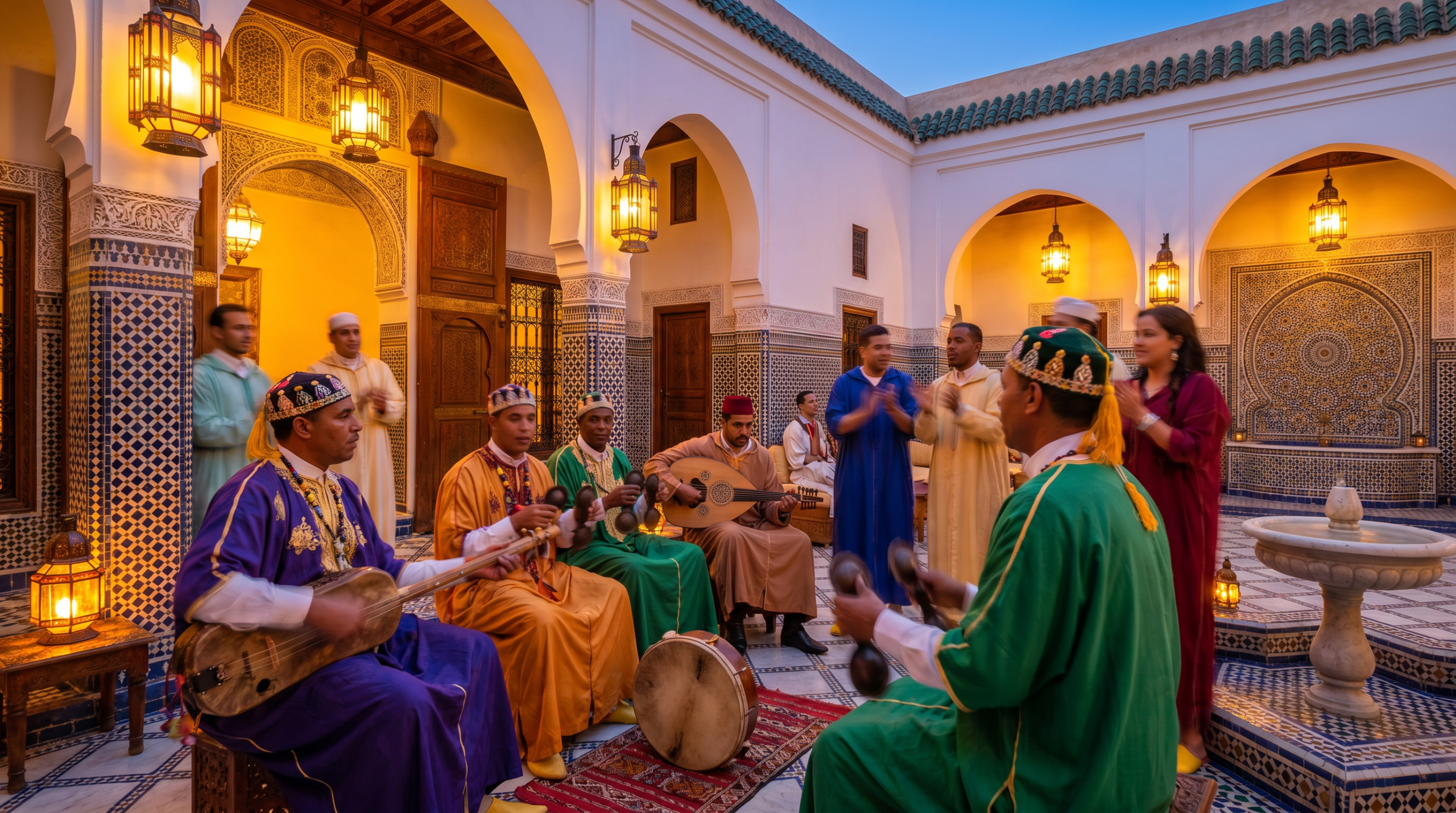
Traditional music evenings in riads provide intimate settings where you sit close to musicians and feel every vibration. Many Moroccan riads offer dinner concerts pairing live traditional music with authentic Moroccan cuisine. For a deeper experience, consider booking a cooking class with a Berber village experience — these often include traditional music performances that let you witness music in its natural social context.
Discovering from Afar
If you can’t travel to Morocco yet, streaming platforms offer curated playlists and archival recordings. Search for Gnawa, Andalusian classical, Amazigh, or Chaabi music to find authentic recordings. The Wikipedia overview of Moroccan music provides additional historical context and links to notable artists worth exploring.
Notable Artists and Groups to Discover
- Mahmoud Guinia — A legendary Gnawa maalem whose recordings capture the tradition at its most powerful and authentic.
- The Andalusian orchestras of Fes and Tetouan — Formal ensembles preserving centuries-old classical compositions.
- Amazigh ensembles from the Atlas Mountains — Groups showcasing the communal vocal and percussion traditions of Berber communities.
- Hassan Hakmoun — A Gnawa artist who pioneered fusion collaborations with Western musicians.
When seeking authentic experiences, prioritize performances in traditional settings over tourist shows. Support local musicians directly. Ask locals for their honest recommendations. And take time to understand the cultural meaning behind what you hear — the music rewards deeper listening with deeper feeling.
Conclusion — A Living Tapestry of Sound
Traditional Moroccan music remains vital in preserving Morocco’s cultural identity and heritage. Through centuries of conquest, trade, migration, and modernization, these musical traditions have adapted while keeping their essential spirit intact. They connect modern Moroccans to their ancestors and share Morocco’s story with the world in a language that transcends words.
The diversity and richness of Moroccan music styles — from the refined mathematics of Andalusian nūbas to the earthy trance of Gnawa ceremonies to the communal joy of Berber Ahidous — reflect a country whose complexity can never be reduced to a single sound. Traditional Moroccan instruments add their irreplaceable voices to this conversation, creating sonic textures you won’t hear anywhere else on earth.
Whether you experience this music in a dusty village square, at a world-renowned festival, in an intimate riad concert, or through headphones at home — let it transport you. Listen for the history in each note. Feel the community in each rhythm. Sense the spirituality in each melody. And if the music moves you to visit Morocco, explore our guides to Moroccan cultural experiences and Sahara Desert tours to plan a journey that engages all your senses.
Reserve Your Spot
Experience Morocco’s Music & Culture
From Marrakech medina tours to Essaouira excursions — discover the sounds and stories of Morocco firsthand. Instant confirmation, free cancellation on most experiences.
Frequently Asked Questions
Everything you need to know about traditional Moroccan music
✦ Your Morocco Journey Starts Here
Let Morocco’s Rhythms Move You 🎶
From the trance-inducing beats of a Gnawa lila to the communal joy of an Atlas Mountain Ahidous, Morocco’s music is an experience that transforms every traveler who truly listens. Don’t just read about it — go hear it for yourself.