Land in Marrakech without a plan for your money and you’ll either overpay at the airport bureau or get talked into a bad rate at the first ATM you meet.
Understanding the currency in Marrakech is the single most useful thing to sort out before you land — get the dirham strategy right and you avoid hidden fees, scams, and the stress of hunting for cash in the medina. The Moroccan Dirham (MAD) isn’t like other currencies: it’s closed and non-convertible, so you can’t buy it at home. This guide covers what MAD actually looks like, current exchange rates, the three best ways to get dirhams, and the ATM rules that save you real money.
Key takeaways
Bring Euros, USD, or GBP — you cannot buy dirhams outside Morocco.
Exchange only a small amount at the airport; use city-center banks or bank-affiliated ATMs for the best rates.
Always decline Dynamic Currency Conversion (DCC) at ATMs — choose “Without Conversion” or “Local Currency (MAD).”
Carry small denominations (50 & 100 MAD notes) for souk haggling and petit taxis.
Re-convert leftover dirhams before airport security — keep your original exchange receipt.
Contents
What is the Marrakech Currency?
Before you can manage your money, you need to know what you’re actually working with.
The Moroccan Dirham (MAD) Explained
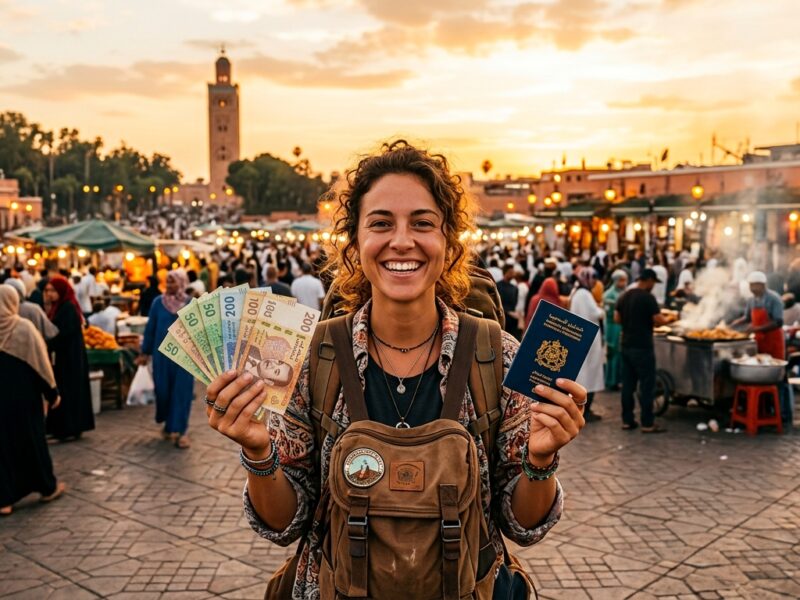
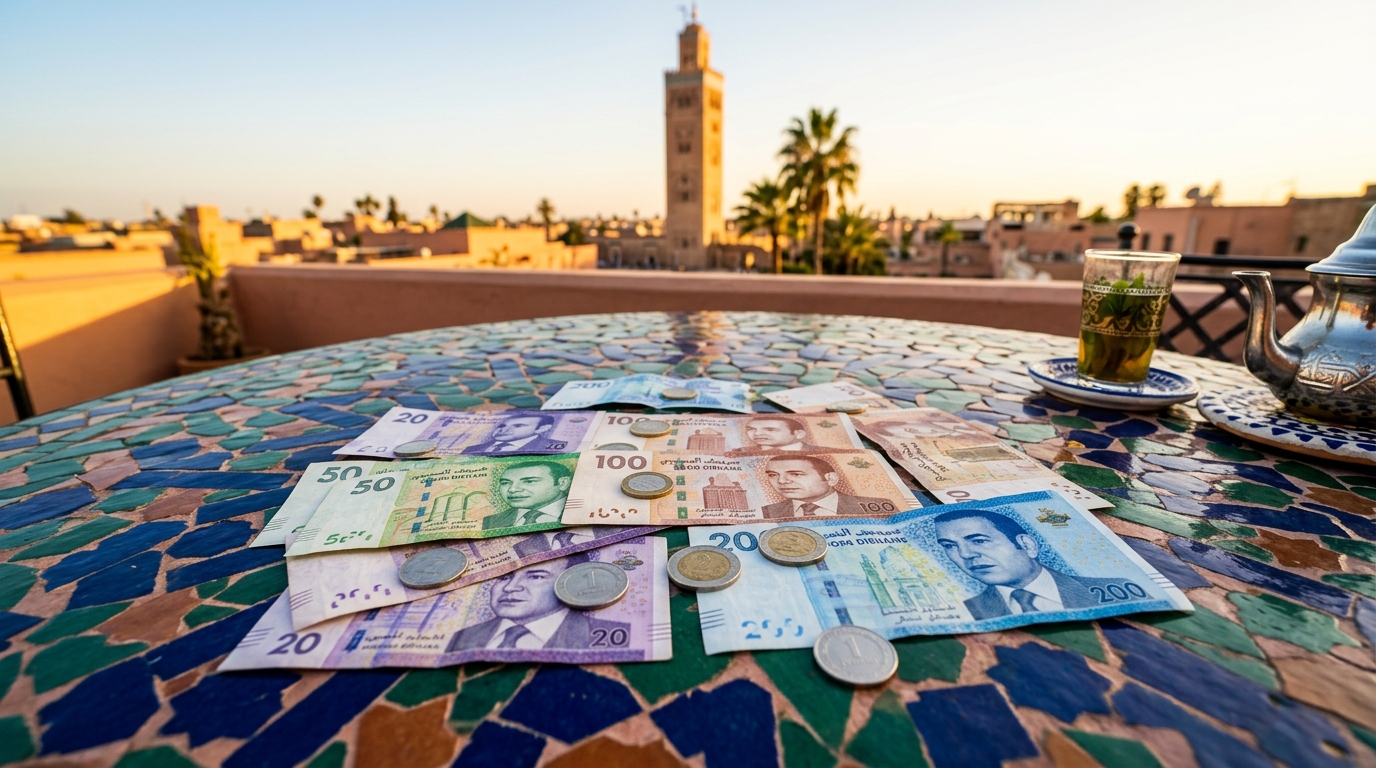
The official currency of Morocco is the Moroccan Dirham — written as MAD, or just DH. One dirham breaks down into 100 centimes, though you’ll rarely handle centime coins day to day.
What you’ll see in your wallet:
- Banknotes: 20, 50, 100, and 200 MAD
- Coins: 1, 2, 5, and 10 dirham pieces, plus smaller centimes
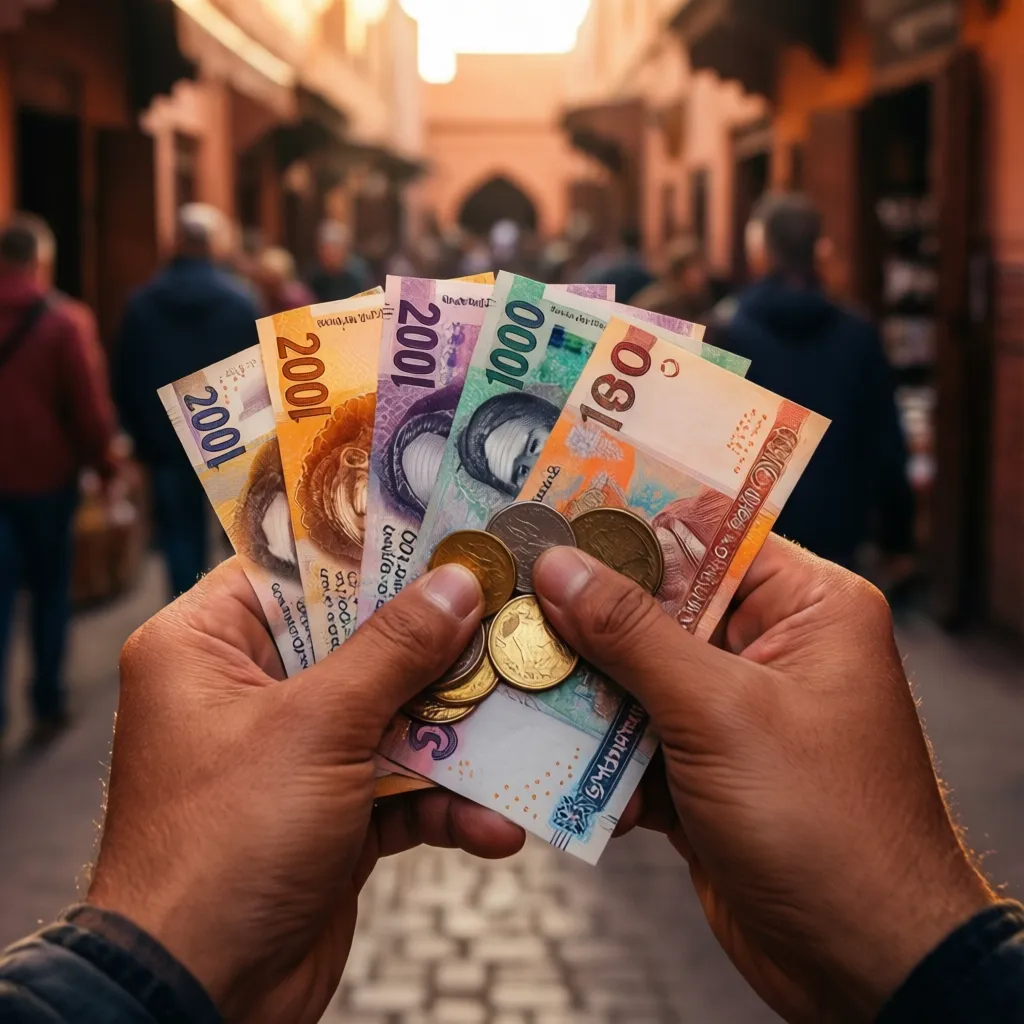
Watch for “Francs.” Some souk sellers quote prices in “Francs” — an old, unofficial way of saying centimes, where one Franc equals one centime. Always confirm you’re actually being quoted in dirhams. Our bargaining tips guide covers this and the rest of the haggling playbook in more detail.
A guided medina walk pairs well with knowing your numbers — our shopping tours page has options, or check availability for a private medina tour on GetYourGuide.
The Non-Convertible Currency Rule
The most important fact about dirhams: you cannot legally buy or sell them outside Morocco. It’s a closed currency, unlike the Euro or US Dollar you can order from your home bank.
The specific limits:
- You can bring up to 2,000 MAD into Morocco (roughly £160 / $200)
- You can take out a maximum of 2,000 MAD when leaving
- Anything over 100,000 MAD must be declared to customs
Since you can’t get dirhams ahead of time, you’ll need foreign cash (Euros, USD, or GBP) or a plan to hit an ATM on arrival. For a smooth start, pre-booking a Welcome Pickups airport transfer means you can head straight to a reliable ATM or bank instead of sorting logistics on landing.
Understanding the Exchange Rate
Plenty of travelers want one clean number for MAD to USD, but rates move daily — a flexible approach beats a memorized figure.
Real-Time Rates vs. Mental Benchmarks
Don’t rely on a static number you found weeks ago. Check live rates on XE.com or search “MAD to USD” right before you leave. As a rough guide going into 2026:
| Currency | Approximate rate |
|---|---|
| £1 GBP | ≈ 12.5 MAD |
| $1 USD | ≈ 9.2 MAD |
| €1 EUR | ≈ 10 MAD |
Treat these as guides only — they shift with global markets.
The “Divide by 10” Mental Trick
A quick mental shortcut: US travelers can roughly divide any dirham price by 10 for a USD estimate — 100 MAD ≈ $10, 50 MAD ≈ $5. UK visitors can divide by 12–13 instead, so 100 MAD is about £8. Not exact, but plenty accurate for a quick call in the souk over a scarf or lantern.
While you’re planning bucket-list moments, check availability for a sunrise hot air balloon ride on GetYourGuide.
Where to Exchange Money
Now the practical part — three main options, each with real trade-offs.
Option 1: Airport Currency Exchange & ATMs
The airport is your first encounter with cash, and it’s convenient — but that convenience costs you. Currency bureaus at Marrakech Airport typically run 2–5% worse than city-center rates.
Only exchange a small amount here — €20–30 (roughly 200–300 MAD), enough for a petit taxi to your riad (usually 70–150 MAD) and a bottle of water.
On the airport ATMs: they sit in the arrivals hall, past baggage claim. A key update for 2026 — Al Barid Bank ATMs at the airport now charge a flat 35 MAD fee per withdrawal for foreign cards, a notable jump from previous years. If you must use an airport ATM, pick a bank-affiliated one — BMCE, Attijariwafa Bank, or Banque Populaire — and avoid Euronet machines entirely; they’re known for poor rates and high fees aimed squarely at tourists.
Option 2: Banks in the City Center
For the best rates, head to an actual bank in town — the safest and most reliable method.
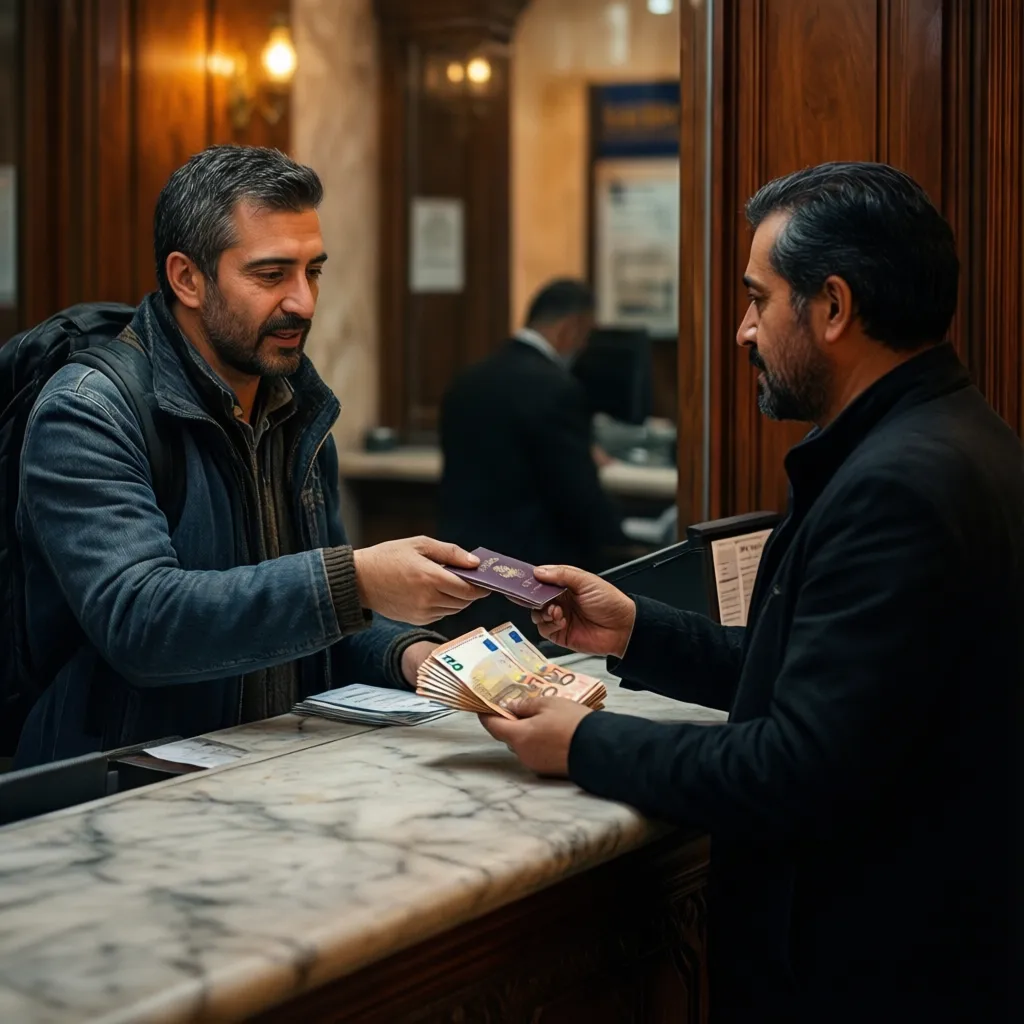
What to do:
- Head to Avenue Mohammed V in Gueliz (the new town)
- Look for BMCE Bank, Attijariwafa Bank, or Banque Populaire
- Bring your passport and foreign cash
- The teller handles the rest
You’ll get close to the official interbank rate with a small commission — almost always the best deal available.
Skip the street changers. Sidewalk “street changers” often advertise tempting rates but are known for short-changing tourists or passing counterfeit notes. Stick to official banks.
Option 3: City ATMs for Ongoing Cash
Once you’re settled, ATMs become the easiest option — just choose carefully. Look for machines attached to a physical bank branch or inside a bank lobby, from a major bank like BMCE or Attijariwafa. Avoid standalone, isolated machines and anything labeled Euronet.
Moroccan ATMs charge a fixed fee per withdrawal, typically 20–40 MAD (€2–4), on top of whatever foreign transaction fee your home bank adds (often around 3%). The smart move: withdraw larger amounts less often — 1,500–2,000 MAD every few days rather than several small withdrawals — so you pay the fixed fee fewer times.
The Golden Rules of Using ATMs
Decline the Conversion (DCC) — Every Time
This is the single most important tip in this guide. When you insert your card, an ATM screen will ask whether to charge you in your home currency or in Moroccan Dirham. Always choose “Without Conversion” or “In Local Currency (MAD).”
Accepting the home-currency option is Dynamic Currency Conversion (DCC) — a trap that bakes in a bad exchange rate and hidden fees. Letting your own bank handle the conversion in MAD is almost always cheaper.
If an ATM offers to charge $100 or 920 MAD, choosing 920 MAD (conversion declined) will almost always work out cheaper — your bank’s rate beats the ATM’s rate nearly every time.
Card Safety & PINs
Tell your home bank you’re traveling to Morocco before you go, or they may flag and block foreign transactions. Use a credit card for withdrawals if your bank’s fees are lower, and keep a debit card as backup — having two options matters if one doesn’t work. For extra peace of mind, EKTA travel insurance covers card theft and emergency cash assistance.
Cash is King: What to Expect When Paying
Morocco runs on cash. Knowing where you’ll need it avoids awkward moments.
Where You Must Use Cash
- Souks: all bargaining and purchases are cash-only
- Petit taxis: almost never have card machines
- Street food: the Jemaa el-Fna stalls
- Small hammams & cafés
- Tips for guides, drivers, and hotel staff
A traditional hammam is worth booking ahead — check availability on GetYourGuide. Jemaa el-Fna’s stalls are also easier with a guide — see availability for a street food tour on GetYourGuide.
Where Cards Are Accepted
Cards work in upscale parts of Gueliz — large hotels, upscale restaurants, the Carrefour hypermarket, and some larger riads. Contactless is growing but far from universal, so don’t count on it. To stay connected for checking balances or maps, grab an Airalo eSIM or Yesim eSIM before you land.
The Haggling Advantage
Small denominations are your secret weapon — always carry 50 and 100 MAD notes. Handing over a 200 MAD note for a small purchase gives a seller an easy excuse to claim they have no change, pushing you toward a higher price.
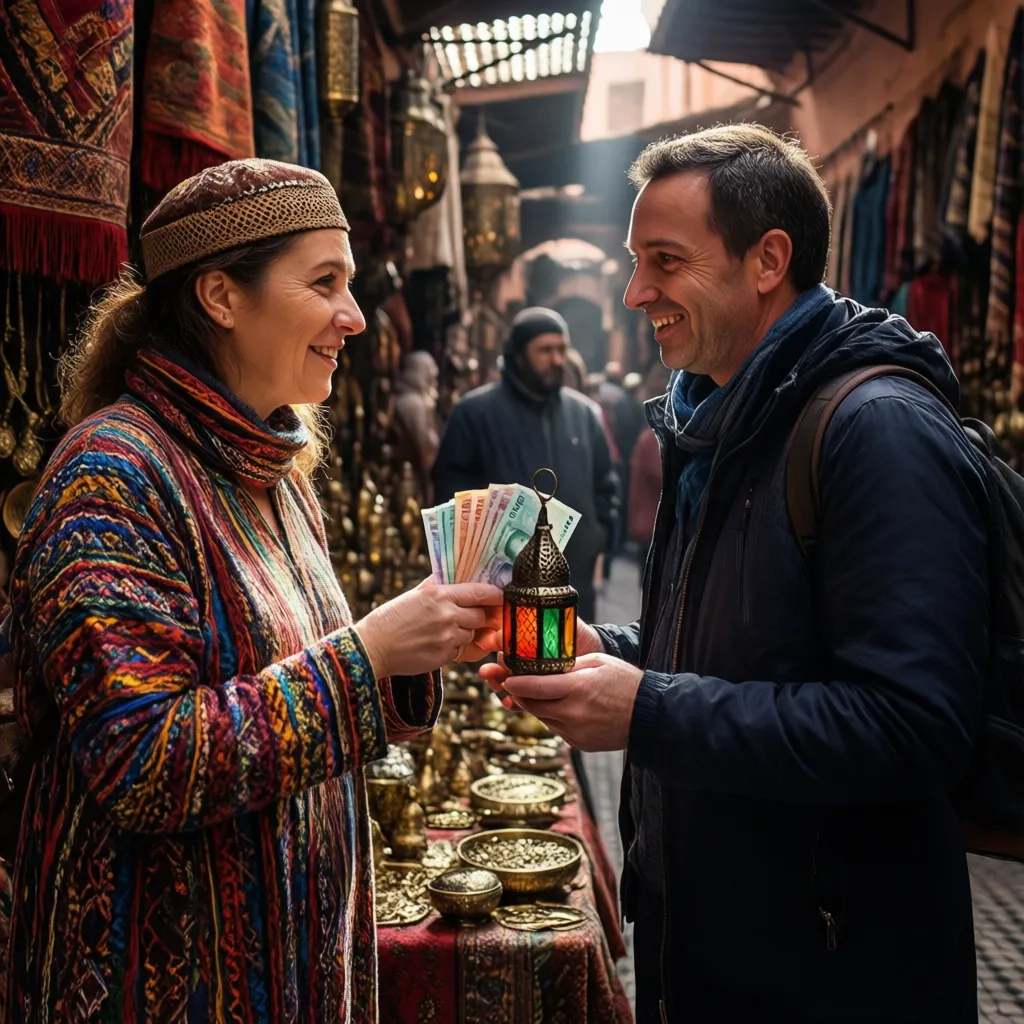
Split your cash: keep a small amount in a front pocket or money belt for the day, and store the bulk in your hotel room safe. Our medina guide covers the souks and palaces in more depth.
What to Do with Leftover Dirhams
Dirhams are close to useless once you leave Morocco, so don’t plan on carrying them home.
The Exit Strategy
Remember the export limit — 1,000 to 2,000 MAD. Stick to the 1,000 MAD figure to stay safe.
- Don’t take leftover dirhams home
- Re-convert them to your home currency at the bureau de change before airport security
- Bring your original exchange receipt — the airport bureau won’t take your cash back without it
Don’t skip the receipt — it’s the one detail people forget until it costs them.
Turning the trip into a full Sahara adventure? Check availability for a camel trek on GetYourGuide.
Conclusion
Your money strategy for Marrakech comes down to three rules:
- Arrival: exchange a small amount at the airport, just enough for a taxi
- Best rate: use banks on Avenue Mohammed V or bank-affiliated ATMs, and always decline Dynamic Currency Conversion
- Spending: cash rules everything — small notes for haggling, the bulk locked in your hotel safe
With money sorted, the next decision is where to stay. Most visitors choose a riad in the medina — see our Riad vs. Hotel comparison, or browse where to stay, budget riads, or our full list of hotels. For general prep, our essential Morocco travel tips cover the rest, and our activities page has more ways to fill the days. Need somewhere to leave your bags on an early arrival or late departure? Radical Storage has you covered.
Reserve your spot
Book Your Marrakech Adventure
From medina tours to Sahara desert camps — choose the experiences that define your trip. Instant confirmation and free cancellation on most tours.
Instant confirmation
Free cancellation on most tours
Some links on this page earn ComeMorocco a commission at no extra cost to you. It never changes what we recommend. How this works.
Questions
01Can I buy Moroccan Dirhams before I travel to Marrakech?
No. The Moroccan Dirham is a closed, non-convertible currency, so you can’t legally buy it outside Morocco. Bring Euros, US Dollars, or British Pounds and exchange them on arrival.
02What is the best way to get cash in Marrakech?
For the best rates, use banks on Avenue Mohammed V in Gueliz (BMCE, Attijariwafa, Banque Populaire) or bank-affiliated ATMs in the city. Avoid airport exchange bureaus and Euronet ATMs.
03Should I accept the ATM’s offer to charge me in my home currency?
Never. Always choose “Without Conversion” or “In Local Currency (MAD).” Accepting the ATM’s Dynamic Currency Conversion means a poor rate and hidden fees.
04How much cash should I carry for a day in the souks?
500–1,000 MAD in small notes (50s and 100s) covers a day of souk shopping, taxi fares, and street food. Keep larger amounts in your hotel safe.
05Can I use credit cards in Marrakech?
Cards are accepted at upscale hotels, restaurants, and large stores in Gueliz, but the medina, souks, petit taxis, and street vendors are cash-only — always carry dirhams.
06What do I do with leftover dirhams at the end of my trip?
Re-convert them at the airport exchange before security. You’ll need the receipt from your original exchange — without it, they won’t take the cash back.
07Are there limits on bringing dirhams in or out of Morocco?
Yes — up to 2,000 MAD (roughly $200/£160) in or out. Amounts over 100,000 MAD must be declared. Stick to 1,000 MAD when leaving to stay safely under the line.
Your Morocco trip
Ready to Experience Marrakech?
You’ve got the money sorted — now book the moments. From sunrise over the Atlas to sunset in the Sahara, your Marrakech trip is one click away.