Standing in front of an empty suitcase, torn between summer clothes and winter layers, unsure about cultural dress codes — this is the single most common moment for anyone putting together a Marrakech packing list for the first time.
If you’re wondering what to pack for Marrakech, you’re not alone. This isn’t a typical beach holiday destination — its climate swings between intense daytime sun and genuinely cool desert evenings, and cultural norms call for more modest clothing than most Western travelers expect. Get the packing wrong and you’ll be uncomfortable, disrespectful, or both. This is a complete Marrakech packing list for every season, built so you can travel light, stay comfortable, and show up dressed right — from the medina’s souks to a quiet riad rooftop at sunset.
Key takeaways
Layering is non-negotiable — day-to-night temperature swings can reach 20°C depending on the season.
Modest dress (covered shoulders and knees) shows respect and helps you blend in, especially in the medina and at religious sites.
Cotton and linen are your best fabrics — breathable in the heat, appropriate, and easy to layer.
A scarf is the single most versatile item — warmth, sun protection, modesty, and style in one piece.
Comfortable, broken-in walking shoes are essential — the medina’s uneven streets demand more walking than you’d think.
Contents
Marrakech Packing List: Climate & Cultural Dress Code
Before you pack a single item, two things decide almost every choice you’ll make: what shows respect, and how to handle Marrakech’s dramatic temperature swings.
Why Modesty Matters
Beyond sunscreen and chargers, the real essentials are the clothing pieces that show cultural respect. In public spaces, especially the medina, both men and women should cover shoulders and knees, and avoid see-through or overly tight clothing.
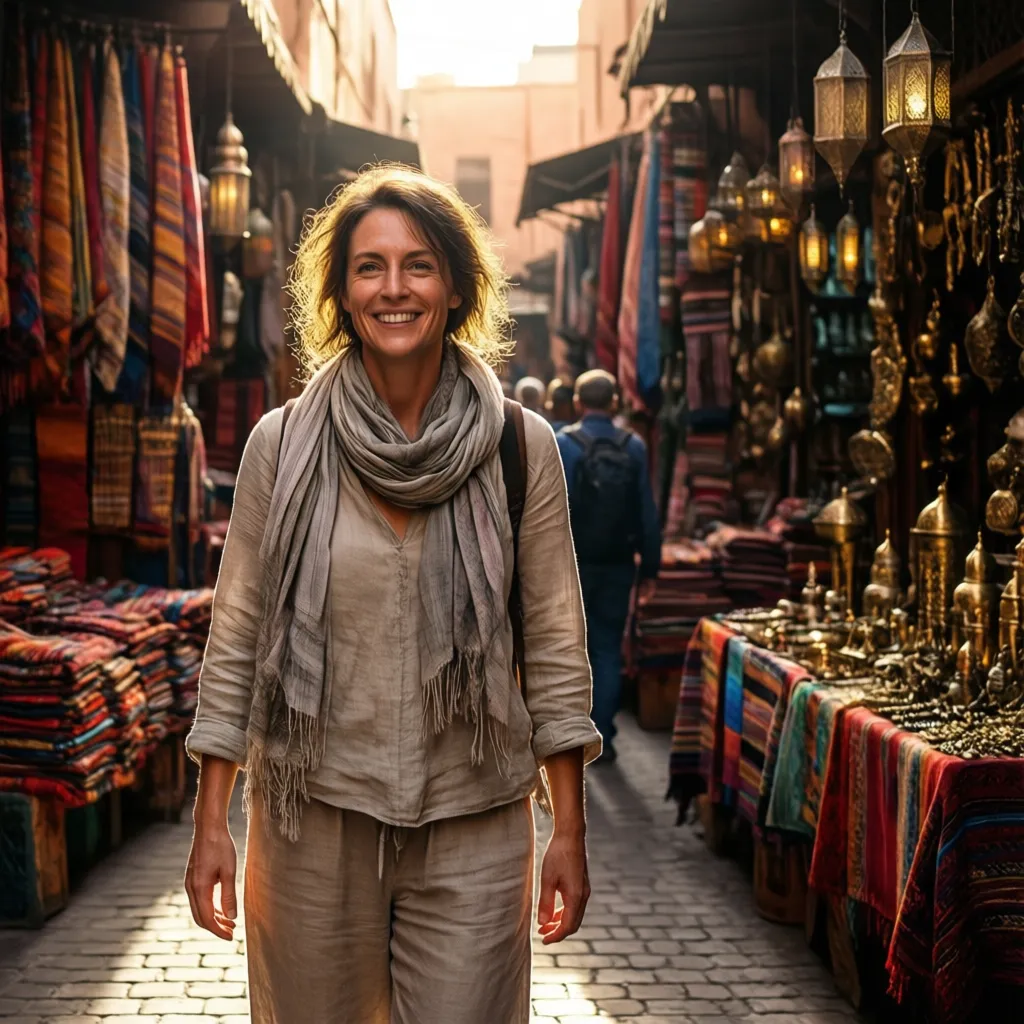
Dress codes vary by area — residential neighborhoods are more conservative, while Gueliz is more liberal and Westernized. At mosques, cover shoulders, chest, and knees; men should wear long trousers and a sleeved shirt. What actually works well in the medina: a light long or midi dress, loose linen or cotton trousers, a below-the-knee skirt, a top that covers the shoulders, or a light scarf carried in your bag for when you need it. Jeans, chinos, and below-the-knee shorts are perfectly acceptable almost everywhere.
Local insight: think of modest dressing not as a restriction but as a way to blend in, avoid unwanted attention, and have a richer experience. You’ll feel more comfortable and more welcome.
Once you’ve got the dress code sorted, a guided medina walk is the easiest way to actually understand what you’re looking at — our shopping tours page has options, or check availability for a private guide on GetYourGuide.
The Layering Principle
When packing for Marrakech, layering is the single most important strategy. Midday heat and evening coolness define the city, and the swing between day and night can hit 20°C depending on the season.
| Season | Low | High |
|---|---|---|
| Winter (Dec–Feb) | 6–9°C | 18–21°C |
| Spring (Mar–May) | 11–15°C | 24–31°C |
| Summer (Jun–Aug) | 20–23°C | 36–41°C |
| Autumn (Sep–Nov) | 13–18°C | 26–34°C |
The practical takeaway: lightweight base layers for the day, plus a warm mid-layer — a cardigan, light jumper, or jacket — for the evening. A scarf is the ultimate transitional piece: warmth, sun protection, and modesty in one.
The Ultimate Marrakech Packing List: Core Staples for Every Season
This is the definitive Marrakech packing list — build your suitcase around these core staples and you’re ready for anything, whatever season you land in.
Footwear: The Key to Comfort
You’ll walk far more than expected. The medina is best explored on foot, over uneven, dusty streets and endless alleyways. Comfortable trainers or sneakers are non-negotiable; sturdy walking sandals with good arch support work well on warm days. For evenings and smarter venues, closed-toe shoes are expected, especially for men. Break in new shoes before you travel — blisters in the medina are miserable.
Daytime Wardrobe: Lightweight & Breathable
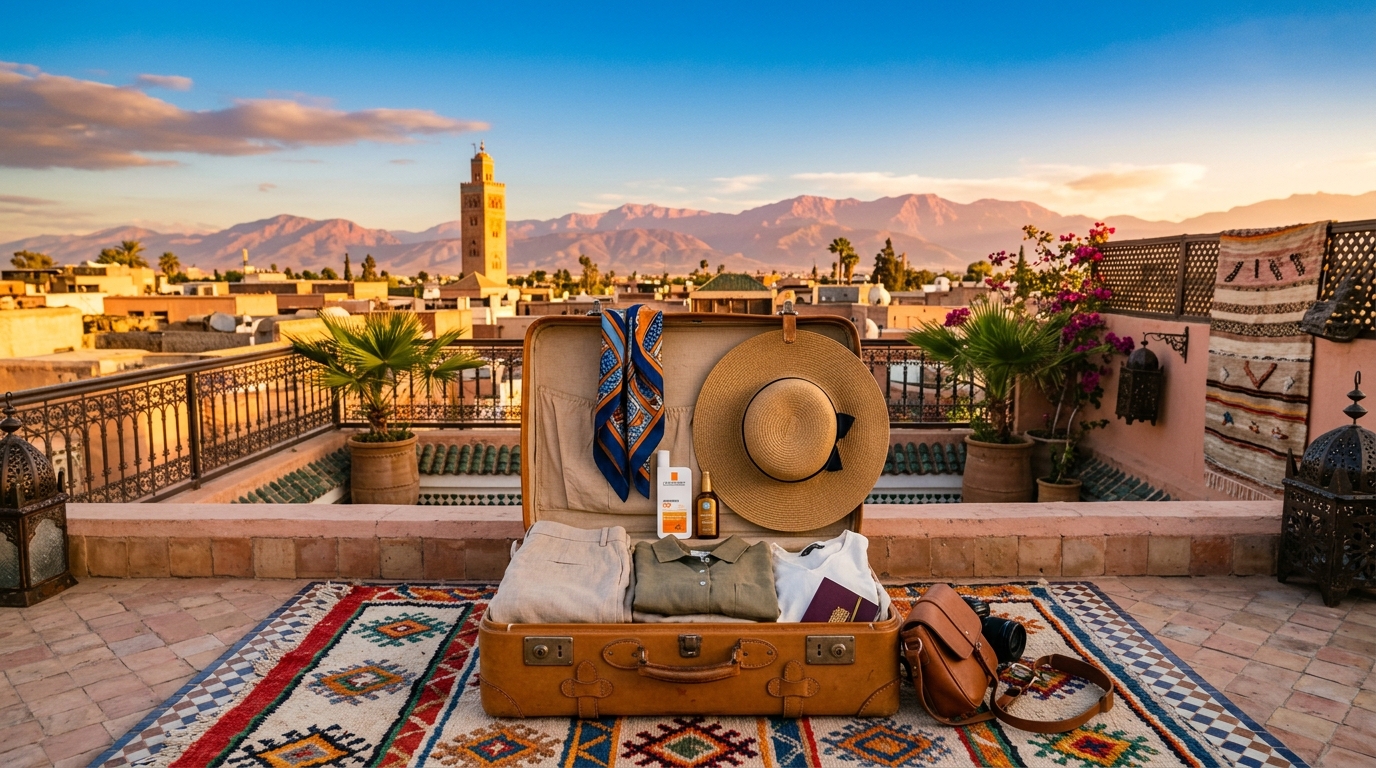
Cotton and linen are the fabrics to prioritize — cool in the heat and culturally appropriate. Pack loose linen or cotton trousers, light long or midi dresses, maxi or below-the-knee skirts, and tops that cover the shoulders. Jeans and chinos work almost everywhere. For men, long trousers with a t-shirt or shirt covers most daytime settings. Carry a light scarf in your bag at all times — it solves the shoulder-coverage problem instantly at a more conservative spot.
Nighttime & Riad Wear
Evening dress code is smart casual at minimum, especially for nicer restaurants, rooftop bars, and social venues. Women: a dress, tailored jumpsuit, or polished top-and-bottom combination. Men: long trousers, closed shoes, and a collared or well-fitted shirt. Skip athletic and gym-style clothing — it’s not appropriate for evening venues. Add a cardigan or light jacket; rooftop dinners get chilly even in summer.
Traditional riads have tiled floors and no central heating. If you’re weighing a riad vs. hotel in Marrakech, pack warm socks and a cozy layer for early mornings, especially in winter — or browse the full range of hotels if central heating matters to you.
The Day Bag: What to Carry into the Medina
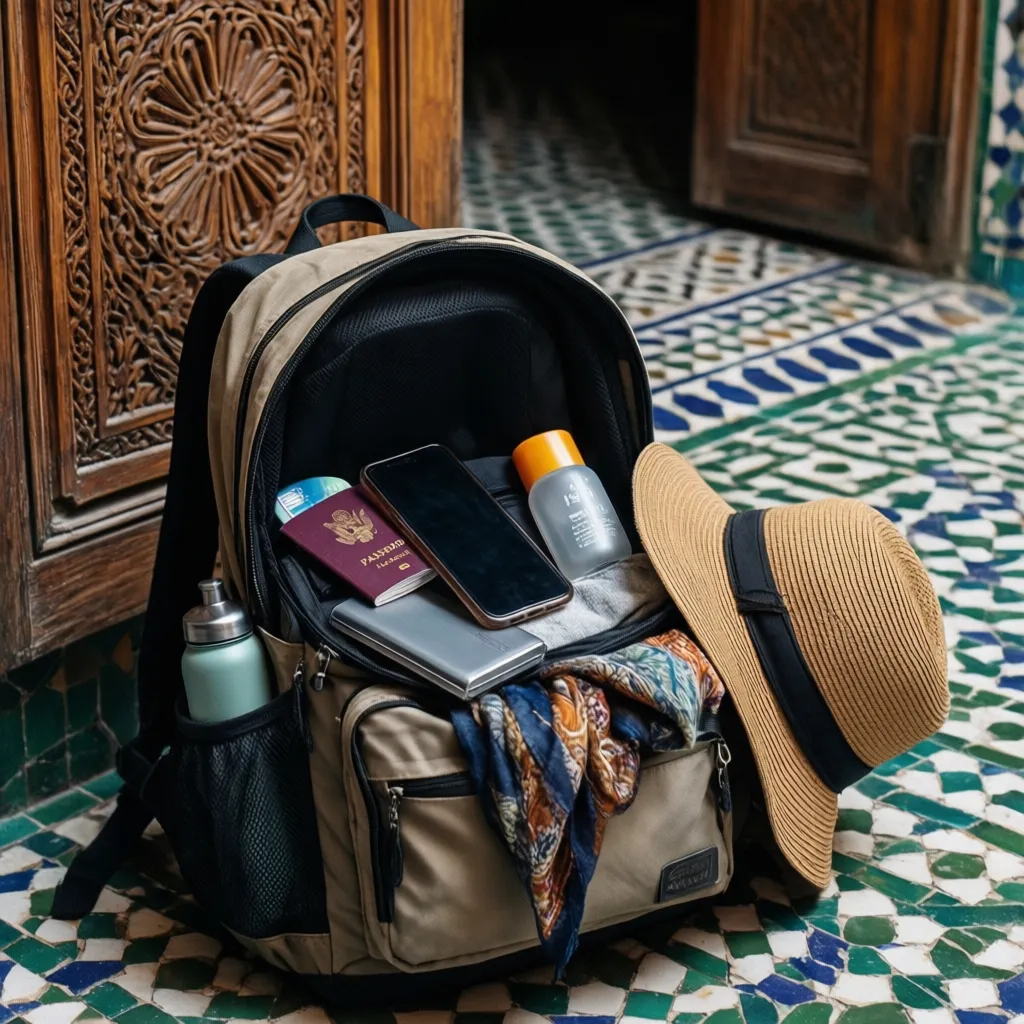
A comfortable day backpack or cross-body bag, packed with:
- Passport and travel documents (keep copies on your phone as backup)
- Phone, charger, and power bank — navigation and the camera get heavy use
- Headphones for flights and quiet moments
- A change of clothes in your carry-on, in case luggage is delayed
- Personal medications, plus a basic first-aid kit
- Snacks and an empty water bottle to refill
- Sunscreen, SPF 30 or higher
- A wide-brimmed hat and UV-protected sunglasses
- Lip balm — the dry, dusty air takes a toll
- At least two scarves — the single most versatile item you’ll pack
- A power adapter for Moroccan outlets (Type C and E)
Staying connected matters for navigation, translation, and booking last-minute experiences — an eSIM lets you activate data the moment you land, no hunting for a physical SIM vendor at the airport.
Hungry for more of the city while you’re at it? Check availability for a Djemaa el-Fna food tour on GetYourGuide.
What to Pack for Marrakech in Spring (March–May)
If you’re wondering what to pack for Marrakech in spring, expect pleasant but variable weather:
- March: high 23°C, low 10°C, ~30mm of rain across 5 days
- April: high 27°C, low 13°C, similar rain to March
- May: high 30°C, low 16°C, only 15mm of rain across 3 days
Pack a light jacket for cool evenings and a scarf for dusty desert winds. Bring a mix of long- and short-sleeved tops for variable conditions, plus a light jumper or cardigan for evenings. Spring is one of the busiest tourist seasons, so comfortable shoes for crowded souk wandering matter more than usual.
It’s also the best season for an Atlas Mountains day trip — wildflowers in the valleys, ideal hiking temperatures, and views to match. See our Atlas Mountains hiking page, or check availability for a day trip on GetYourGuide.
What to Pack for Marrakech in Summer (June–August)
Packing for Marrakech in summer means planning around real intensity — daytime highs can hit 41°C — but the right gear keeps it manageable.
Sun Protection: The Absolute Priority
SPF 30+ sunscreen, reapplied through the day, is non-negotiable. A wide-brimmed hat, UV-protected sunglasses, and SPF lip balm round out the kit.
Fabrics to Seek vs. Avoid
Seek lightweight, breathable cotton and linen. Avoid synthetics — they trap heat and moisture. Loose-fitting clothing is genuinely cooler than tight clothing in extreme heat: loose linen trousers and airy dresses are the summer staples. Even in summer, long, loose clothing shields better against the sun than shorts and tank tops.
Pool & Riad Lounging
Many riads have beautiful pools — pack swimwear plus a lightweight cover-up or kaftan for walking from the pool to your room, since modesty still applies beyond the poolside. Flip-flops or pool slides help, and a reusable water bottle keeps you hydrated in 36–41°C heat.
Planning note: summer is low season for tourism — you’ll find better rates on affordable riads in Marrakech and shorter queues at major attractions.
What to Pack for Marrakech in Autumn (September–November)
Autumn is the sweet spot for a Marrakech packing list. September still feels like summer, with highs around 25–30°C. If you’re specifically wondering what to pack for Marrakech in November, treat it as the cooler tail end of autumn — lows of 13–18°C and highs of 26–34°C. Rain is low to moderate, so a light rain layer is sensible but optional.
Pack light sweaters and pashminas for cooler evenings, plus a versatile jacket that carries you from warm afternoons into crisp nights. The same layering principle applies, just with slightly warmer mid-layers than summer — light dresses and sandals by day, a cardigan and closed-toe shoes at night.
What to Pack for Marrakech in Winter (December–February)
Marrakech isn’t warm year-round, and winter nights catch a lot of travelers off guard. Whether you’re figuring out what to pack for Marrakech in December, January, or February, the same rule applies: sunny days, genuinely cold nights.
The Heavy Coat & Thermal Layer
Winter highs reach 18–21°C, but lows drop to 6–9°C. Days are sunny and pleasant; nights are genuinely cold, especially in unheated riads. A warm jacket or coat isn’t optional. Thermal base layers help for early mornings and late evenings, and pack warm socks with closed-toe shoes or boots.
Why a Scarf Is Your Best Friend in Winter
A thick scarf provides warmth against cold desert winds, doubles as a modesty cover at religious sites, and elevates a simple outfit for evening dinners. Its versatility is unmatched — warmth, style, cultural respect, and sun protection in one item. And yes, you still need sunscreen — winter sun in Marrakech is surprisingly strong.
Winter is peak season for Sahara desert tours from Marrakech — book 2–3 months ahead for the best camel trek and desert camp options.
Between packing sessions, a traditional hammam is a good way to unwind — check availability on GetYourGuide.
That’s the complete Marrakech packing list, whatever month you land — from a light summer capsule wardrobe to full winter layers for December, January, or February.
A Few Practical Extras
Luggage storage: early arrival or late departure? Radical Storage lets you book secure storage near major landmarks so you can explore hands-free.
Stay connected: activate data the moment you land with Airalo or Saily — no physical SIM hunting required.
Airport transfer: pre-book a Welcome Pickups transfer for a fixed price, flight tracking, and an English-speaking driver waiting at arrivals.
Flight delays: if your flight is delayed or cancelled, Compensair can help you claim up to €600, no win no fee.
And if Moroccan flavors are half the reason you’re going, a hands-on cooking class is worth booking before you land — check availability on GetYourGuide.
Further reading: Wikipedia: Marrakech, the Morocco Tourism Board, and UNESCO World Heritage Sites in Morocco.
Reserve your spot
Book Your Marrakech Experience
From medina tours to a sunrise hot air balloon ride — instant confirmation and free cancellation on most tours.
Instant confirmation
Free cancellation on most tours
Some links on this page earn ComeMorocco a commission at no extra cost to you. It never changes what we recommend. How this works.
Questions
01What should women wear in Marrakech to be respectful?
Cover shoulders and knees in public spaces. Loose linen trousers, midi/maxi dresses, long skirts, and sleeved tops all work well. Carry a lightweight scarf to drape over your shoulders in more conservative areas or at religious sites.
02Is Marrakech safe for solo female travelers?
Yes, generally, with standard precautions: dress modestly, avoid walking alone in the medina late at night, use official taxis or pre-booked transfers, and stay in well-reviewed riads or hotels.
03Do I need a power adapter for Morocco?
Yes. Morocco uses Type C and Type E plugs (220V, European standard). Bring a universal adapter if your devices use UK, US, or other plug types — a multi-port USB charger is handy too, since outlets in riads can be limited.
04Can I wear shorts in Marrakech?
Below-the-knee shorts are fine for both men and women in most areas, including the medina. Short shorts are considered inappropriate outside pool or beach areas. When in doubt, lightweight linen trousers are cooler and always appropriate.
05What’s the best time of year to visit Marrakech?
Spring (March–May) and autumn (September–November) offer the most pleasant temperatures with minimal rain. Summer (June–August) is extremely hot (36–41°C) but quieter and cheaper. Winter (December–February) brings sunny days but genuinely cold nights (6–9°C), so pack warm layers.
06How do I get from Marrakech airport to the city center?
Menara Airport is only 5–6 km from the center. Options: a pre-booked private transfer (most reliable, fixed price), official airport taxis (agree the fare before departure), or the L19 airport bus (budget-friendly). A pre-booked Welcome Pickups transfer removes most of the arrival stress.
07Should I book tours and activities in advance?
For popular experiences — Sahara desert tours, hot air balloon rides, cooking classes, and guided medina tours — book 2–4 weeks ahead, especially in spring or autumn. Day trips to Essaouira, Ourika Valley, or Ouzoud Falls can usually be booked 2–3 days out, and riad-hosted hammams or rooftop dinners often take same-day requests.
Your Morocco trip
Pack Smart, Travel Deeper
You’ve got the packing list. Now imagine mint tea on a riad rooftop, the call to prayer over the medina at sunset, and Djemaa el-Fna coming alive after dark. Every trip starts with a single, well-packed suitcase.