
Mosques in Morocco: 10 Breathtaking Sacred Masterpieces You Must See in 2026
Discover Morocco’s 10 most breathtaking mosques with our complete guide. Explore the architectural marvels of Hassan II, Koutoubia, and more with expert visiting tips for 2026.
What does it feel like to stand beneath a minaret so tall it seems to pierce the heavens, with waves from the Atlantic crashing just meters below your feet? In Morocco, mosques are not simply places of prayer — they are living monuments to centuries of artistic genius, spiritual devotion, and the extraordinary fusion of Arab, Amazigh, Andalusian, and Mediterranean cultures. From the world’s tallest religious structure in Casablanca to an unfinished tower in Rabat that whispers of empires that dared to dream beyond their reach, the mosques in Morocco tell stories that no guidebook can fully capture.
This comprehensive Morocco mosque guide takes you inside (and outside) the most stunning sacred spaces the kingdom has to offer. Whether you’re an architecture enthusiast captivated by geometric perfection, a history lover tracing the footprints of dynasties, or a traveler seeking moments of genuine spiritual beauty, these famous mosques in Morocco will transform your understanding of this enchanting North African nation.
✦ Key Takeaways
Morocco’s mosques showcase centuries of Islamic architectural tradition blending Arab, Amazigh, and Andalusian craftsmanship
The Hassan II Mosque in Casablanca is Morocco’s largest mosque and features the world’s tallest minaret at 210 meters
Koutoubia Mosque’s iconic minaret influenced Islamic architecture across the western Mediterranean including Seville’s Giralda
Hassan Tower in Rabat stands as a fascinating unfinished monument that would have been the world’s largest mosque
Visitors should observe proper dress codes and etiquette — the Hassan II Mosque and Tin Mal Mosque offer guided tours for non-Muslims
Mosques in Morocco: A Journey Through Architectural Splendor and Spiritual Heritage
Mosques in Morocco stand as magnificent testaments to centuries of cultural exchange, artistic mastery, and deep spiritual devotion. These sacred spaces represent far more than places of worship — they embody the very soul of Moroccan heritage, weaving together Arab, Amazigh, Andalusian, and Mediterranean influences into breathtaking architectural masterpieces. From the towering minarets that pierce the sky to the intricate geometric patterns that adorn their walls, each mosque tells a unique story of faith, artistry, and cultural identity.
Throughout the kingdom, mosques serve as the beating heart of communities. These sacred spaces function not only as places for daily prayers but also as centers for education, community gathering, and even dispute resolution. The mosque tradition in Morocco extends beyond religious practice, creating spaces where neighbors meet, children learn, and communities strengthen their bonds across generations.
💡 Morocco has approximately 50,000 mosques — more per capita than almost any other country. Even the smallest village typically features a beautifully maintained mosque at its center, reflecting the deep integration of Islamic faith into daily Moroccan life.
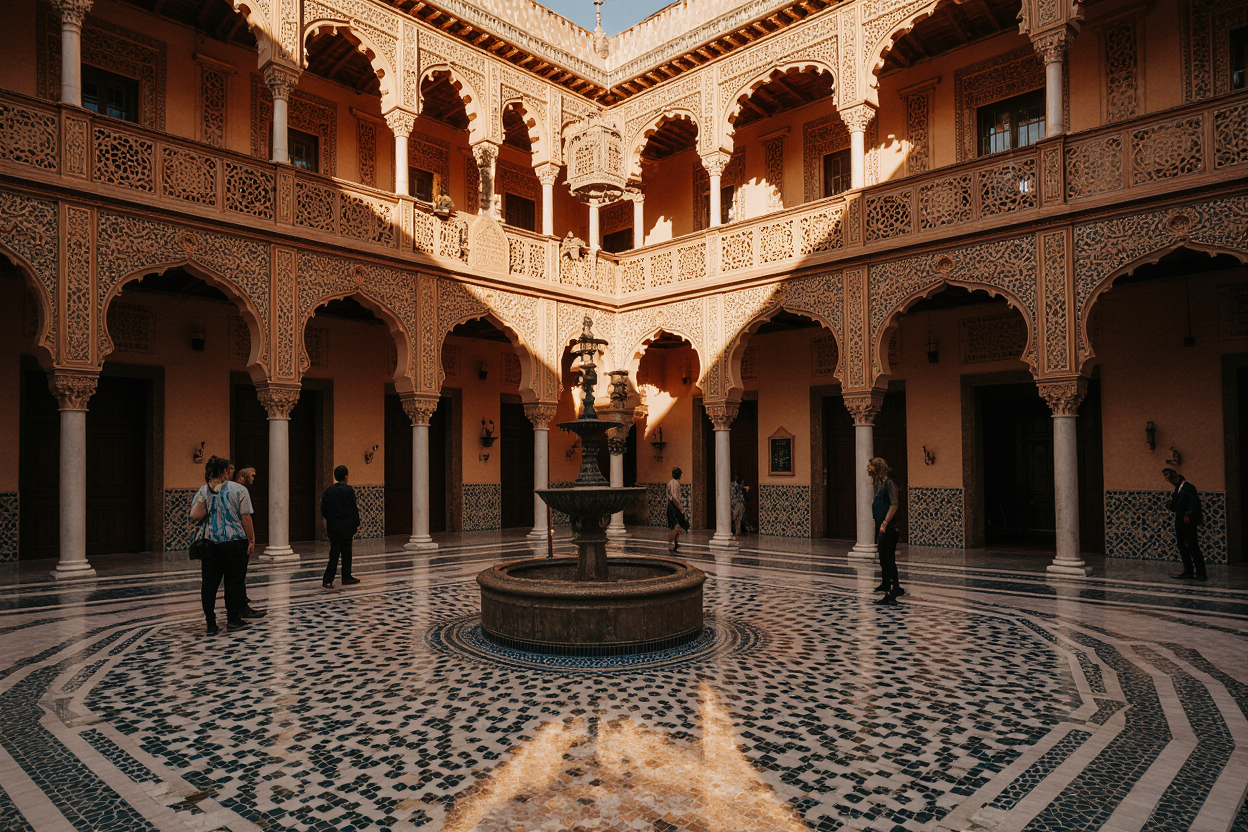
The architectural style of beautiful mosques across Morocco is truly distinctive. Master craftsmen have perfected techniques passed down through generations, creating stunning examples of Islamic art that are recognized worldwide. Key features include zellij tilework — intricate geometric mosaics covering walls and floors with mesmerizing patterns; carved wood and plaster featuring delicate arabesque designs; horseshoe arches that have become synonymous with Moroccan architectural tradition; and towering square minarets that call the faithful to prayer and serve as city landmarks visible for miles.
Each region brings its own flavor to mosque design. Imperial cities like Fez and Marrakesh boast grand mosques with elaborate decoration, while rural areas feature simpler structures that blend harmoniously with their natural surroundings. The influence of different dynasties — from the Almoravids to the Alaouites — can be traced through this architectural evolution. Each ruling family left its mark, contributing new techniques and styles that enriched the tradition. Understanding Morocco’s rich history provides essential context for appreciating these architectural marvels and the civilizations that built them.
Famous mosques across Morocco reflect the spiritual and cultural identity of the nation. Today, these buildings stand as living museums, preserving centuries of artistic achievement and religious devotion while continuing to serve their communities in prayer five times each day.
Powered by GetYourGuide
Hassan II Mosque — Casablanca’s Crown Jewel
The Hassan II Mosque in Casablanca rises majestically from the Atlantic coastline, claiming its place as Morocco’s largest mosque and one of the most spectacular religious buildings in the world. This modern marvel, completed in 1993, combines traditional Moroccan craftsmanship with cutting-edge engineering in a way that leaves every visitor breathless.
Standing at an impressive 210 meters tall, the minaret of the Hassan II Mosque is the tallest religious structure on Earth. The mosque’s unique location — built partially over the ocean — was inspired by a Quranic verse stating that God’s throne was built upon water. This symbolic placement creates a breathtaking sight as waves crash against the mosque’s foundation during high tide, making worshippers feel as though they are praying upon the sea itself.
A powerful laser beam shoots from the summit of the Hassan II Mosque’s minaret toward Mecca, visible for up to 30 kilometers at night. It’s the only mosque in the world with this feature, serving as both a spiritual compass and a stunning visual beacon across Casablanca’s skyline.
The architectural features of the Hassan II Mosque showcase the finest Moroccan artistry at an almost incomprehensible scale. Over 10,000 artisans worked for six years to create the stunning geometric mosaics, hand-carved cedar ceilings, and marble floors heated from below for winter comfort. The prayer hall features a retractable roof that opens in just three minutes, allowing worshippers to pray under the stars — a feature that symbolizes the connection between earth and heaven. Massive Venetian crystal chandeliers illuminate the interior, and titanium-covered doors reflect the play of ocean light.
What makes the Hassan II Mosque among the most famous in Morocco is its remarkable accessibility to non-Muslim visitors. Guided tours allow people of all faiths to step inside and appreciate the mosque’s extraordinary beauty. Visitors should dress modestly, with women covering their hair and everyone removing shoes before entering. Morning tours offer the softest light for photography and the smallest crowds. When exploring Casablanca, consider taking a half-day city tour that includes this magnificent landmark along with other highlights of Morocco’s largest city.
📌 Planning note: Hassan II Mosque tours run at set times (usually 9am, 10am, 11am, and 2pm) except during Friday prayers. Tickets cost approximately 130 MAD (about €12). Arrive 15 minutes early — tours sell out during peak season. The mosque can accommodate 25,000 worshippers inside and 80,000 in its vast courtyard.
The Hassan II Mosque represents a bridge between Morocco’s rich past and its modern aspirations. Every detail reflects the nation’s commitment to preserving traditional crafts while embracing contemporary innovation. For deeper insight into the spiritual traditions that inspire these sacred spaces, explore our guide to Islam in Morocco and its profound cultural influence.
Powered by GetYourGuide
Koutoubia Mosque — The Heart of Marrakesh
The Koutoubia Mosque in Marrakesh stands as one of the most iconic and beloved mosques Morocco has ever produced. Built in the 12th century under the Almohad dynasty, this architectural masterpiece has earned its place as a UNESCO World Heritage component and serves as the undisputed spiritual heart of the Red City.
Rising 77 meters into the Marrakesh sky, the Koutoubia’s minaret dominates the city’s skyline like a compass needle pointing skyward. Its distinctive pink sandstone construction glows warmly in the changing light, shifting from rose to amber as the sun traces its path across the sky. The name “Koutoubia” comes from the Arabic word kutubiyyin — bookseller — as the mosque once stood in the midst of a bustling manuscript market where scholars traded knowledge.
The architectural significance of the Koutoubia extends far beyond its beauty. Its minaret served as the prototype for two other famous structures: the Giralda in Seville, Spain, and the Hassan Tower in Rabat. This influence spread throughout the Maghreb and into Andalusia, making the Koutoubia a cornerstone of Islamic architecture in the western Mediterranean. Key features include intricate geometric patterns covering the minaret with interlocking shapes that create optical illusions; horseshoe and multifoil arches demonstrating mathematical precision; green and white ceramic tiles forming diamond patterns on the upper sections; and four golden copper globes crowning the summit, surrounded by centuries of legend about their composition.
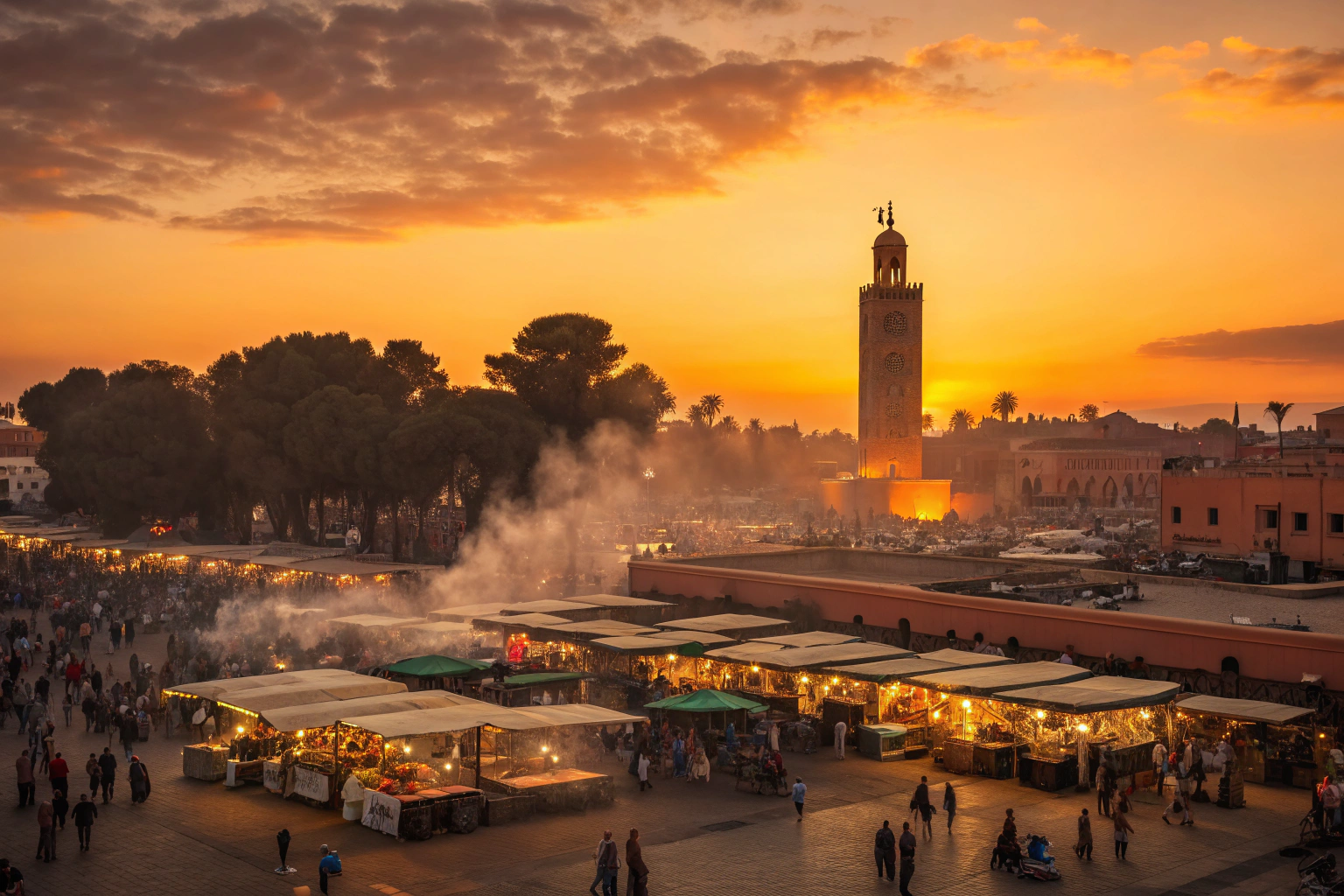
The most iconic photographs of the Koutoubia Mosque come from the nearby Jemaa el-Fnaa square at sunset, when the minaret glows amber against the darkening sky. For a less crowded angle, try the gardens on the mosque’s south side during golden hour — the rose bushes frame the minaret beautifully.
While non-Muslims cannot enter the prayer hall — which accommodates up to 25,000 worshippers — the exterior and surrounding gardens alone make the Koutoubia one of the most rewarding mosques in Morocco to visit. The mosque grounds include beautiful gardens where locals gather, making it a living part of the city’s social fabric. If you’re exploring Marrakech and other Moroccan destinations, this iconic monument should be at the top of your list. Experience the vibrant surroundings with a free walking tour of the Marrakech Medina that highlights the Koutoubia and other landmarks.
Powered by GetYourGuide
Hassan Tower — Rabat’s Unfinished Monument
The Hassan Tower in Rabat presents perhaps the most fascinating chapter in the story of famous mosques across Morocco. This unfinished minaret stands as a powerful symbol of ambition, loss, and the passage of time — offering visitors a uniquely poetic glimpse into what could have been the world’s largest mosque.
Commissioned in 1195 by the Almohad Sultan Yacoub al-Mansour, the Hassan Tower was intended to be part of a mosque that would dwarf all others in the Islamic world. The sultan envisioned a religious complex that would cement his legacy and demonstrate the unrivaled power of the Almohad empire. However, his death in 1199 brought construction to an abrupt halt, leaving behind only the minaret — standing at 44 meters, exactly half its planned 86-meter height — and a haunting forest of 348 stone columns that would have supported the prayer hall’s roof.
The architectural features of this Rabat monument reveal its intended grandeur. Built from the same warm red sandstone used in many beautiful mosques across Morocco, the tower features a remarkable design detail: each of its four facades displays a different geometric pattern of blind arches and carved ornamentation, so it never looks the same from any angle. An interior ramp — wide enough for horses to climb — spirals upward instead of stairs, reflecting the scale at which this structure was conceived.
💡 The 1755 Lisbon earthquake — felt across Morocco — destroyed much of the remaining mosque structure, but the Hassan Tower survived. The 348 columns standing today were originally part of a planned 400, each carved from a single piece of stone. Walking among them at sunset, with shadows stretching between the pillars, is one of Morocco’s most atmospheric experiences.
Today, the Hassan Tower site forms part of a larger complex that includes the stunning Mausoleum of Mohammed V, where Morocco’s former king and his two sons rest. Completed in 1971 by Vietnamese architect Vo Toan, the mausoleum showcases contemporary Moroccan craftsmanship — white Italian marble, hand-carved cedarwood, and zellij tilework — while respecting traditional design principles. The juxtaposition of the ancient unfinished tower and the immaculate modern mausoleum creates one of Morocco’s most powerful architectural dialogues.
Visitors can explore this open-air monument freely throughout the day. The elevated platform offers panoramic views of Rabat and the Bou Regreg river, making it a favorite spot for both tourists and locals. Taking a city tour of Rabat is an excellent way to visit this monument along with other highlights of the capital.
Powered by GetYourGuide
Other Famous and Beautiful Mosques in Morocco
Beyond the three major landmarks, Morocco hosts numerous other extraordinary mosques that reward travelers who venture deeper. Each tells its own story and contributes to the rich tapestry of Islamic architecture and spiritual heritage across the kingdom.
Al Quaraouiyine Mosque — Fez
Founded in 859 CE by Fatima al-Fihri, a visionary woman whose legacy continues to inspire, the Al Quaraouiyine Mosque holds the extraordinary distinction of being one of the oldest continuously operating universities in the world — recognized by UNESCO and the Guinness World Records. With capacity for 20,000 worshippers, it features a library containing rare manuscripts dating back centuries, beautiful courtyards with marble columns, and intricate stucco work and cedar wood carvings that represent the pinnacle of Fessi craftsmanship.
While exploring Fez, consider taking a guided tour of the Fes Medina to learn about this historic mosque and the other cultural treasures hidden within the labyrinthine old city. Non-Muslims cannot enter the prayer hall, but the courtyard glimpses through ornate doorways are unforgettable.
Tin Mal Mosque — High Atlas Mountains
Nestled in the remote High Atlas Mountains, the Tin Mal Mosque represents a rare and remarkable example of Almohad architecture that non-Muslims can enter and explore freely. Built in 1156 at the birthplace of the Almohad movement, this mosque survived centuries of earthquakes and remains remarkably intact. Its simple yet powerful design — massive stone walls, soaring arches, and a serene courtyard open to the mountain sky — influenced many later mosques across Morocco, including the Koutoubia itself.
Located in one of the unique villages of Morocco, Tin Mal offers a glimpse into the country’s rural heritage that few tourists ever experience. For outdoor enthusiasts, combining a visit here with trekking in the Atlas Mountains creates an unforgettable day that blends spiritual history with natural grandeur.
Tin Mal is approximately 100 km south of Marrakech along the spectacular Tizi n’Test mountain pass. The road itself is one of Morocco’s most dramatic drives, with hairpin turns and Atlas panoramas. Renting a car gives you the flexibility to stop at viewpoints along the way, or join an organized day trip from Marrakech.
Moulay Idriss Mosque — Moulay Idriss Zerhoun
The Moulay Idriss Mosque in the hillside town of Moulay Idriss Zerhoun serves as one of Morocco’s holiest pilgrimage sites. Dedicated to Moulay Idriss I, who brought Islam to Morocco in the 8th century, this mosque features a distinctive cylindrical minaret — unique in all of Morocco — and green-tiled roofs visible from the surrounding hills. Its sacred status draws thousands of pilgrims annually, and the entire town radiates a palpable spiritual energy.
Visiting this important site can be combined with a trip to the nearby Roman ruins of Volubilis. Consider taking a day trip to Volubilis & Meknes that includes Moulay Idriss for a comprehensive historical experience spanning Roman, Islamic, and Imperial Moroccan heritage.
Grand Mosque of Meknes
Built in the 12th century and extensively restored under Sultan Moulay Ismail in the 17th century, the Grand Mosque of Meknes stands in the heart of one of Morocco’s four imperial cities. Its green-tiled roof, elaborate doorways, and position near the famous Bab Mansour gate make it a central feature of the Meknes medina. The mosque’s architectural elements blend Almohad foundations with Alaouite refinements, creating a layered testament to Moroccan dynastic history.
Grand Mosque of Tangier
Overlooking the Strait of Gibraltar from the ancient medina, the Grand Mosque of Tangier occupies a site that has served as a place of worship for millennia — it was originally a Roman temple, then a Portuguese cathedral, before becoming a mosque in the 17th century. This layered history is typical of Tangier itself, a city that has always existed at the crossroads of civilizations.
Grand Mosque of Chefchaouen
In the heart of Morocco’s famous Blue City, the Grand Mosque of Chefchaouen features an unusual octagonal minaret that stands in beautiful contrast to the square minarets found elsewhere in Morocco. Set against the town’s iconic blue-washed walls and with the Rif Mountains as a backdrop, it creates one of the most photographed religious scenes in North Africa.
Grand Mosque of Sale
Just across the Bou Regreg river from Rabat, the Grand Mosque of Sale dates to the 12th century and features one of Morocco’s finest examples of Merinid-era architecture. Its elaborately carved main entrance and attached madrasa (Islamic school) showcase the refinement of this often-overlooked medieval dynasty.
These mosques in Morocco demonstrate the incredible diversity of Islamic architecture across the country. From ancient foundations to mountain sanctuaries, each contributes to Morocco’s reputation for hosting some of the most beautiful and historically significant mosques in the Islamic world. Many of these sites can be found among the hidden gems throughout Morocco that reward travelers who venture beyond the main tourist routes.
Powered by GetYourGuide
Morocco Mosque Guide: Visiting Tips for 2026
Planning to explore the magnificent mosques in Morocco requires some preparation and cultural awareness. These practical tips will help you make the most of your visits while showing proper respect for these sacred spaces.
Dress Code & What to Wear
Modest dress is essential when visiting any mosque in Morocco, even if you’re only viewing the exterior. Women should wear loose-fitting clothes covering arms and legs, and headscarves are required inside mosques open to visitors. Men should avoid shorts and sleeveless shirts. Bringing a lightweight scarf that can serve as both a headcovering and a wrap is one of the smartest packing decisions you’ll make. Understanding proper Moroccan etiquette will enhance your mosque visits and all cultural experiences throughout your journey.
Visiting Hours & Accessibility
Most working mosques in Morocco are closed to non-Muslims — this is standard practice and should be respected without question. The major exception is the Hassan II Mosque, which offers specific tour times for visitors of all faiths. The Tin Mal Mosque in the High Atlas is another accessible option. For all other mosques, admire the architecture from outside, photograph the exteriors, and listen for the hauntingly beautiful adhan (call to prayer) that echoes across every Moroccan city five times daily.
📌 Important: Friday afternoon is the busiest time at all mosques due to Jumu’ah (Friday congregational prayers). Plan your visits for Saturday through Thursday mornings for the quietest experience. During Ramadan, prayer schedules shift significantly — check locally for updated tour times at the Hassan II Mosque.
Cultural Etiquette Inside Mosques
When you do have the opportunity to enter a mosque, always remove your shoes before stepping onto prayer areas. Maintain quiet, respectful behavior — speak in hushed tones and avoid loud laughter or animated conversations. Ask permission before photographing people, and never point your feet toward the qibla (the direction of Mecca, typically marked by a niche in the wall called the mihrab). Follow your guide’s instructions carefully, and remember that you are a guest in a sacred space.
For women visiting Morocco, our guide on women traveling in Morocco provides valuable safety tips and cultural insights that apply to mosque visits and beyond.
Best Times to Visit
The best time to visit mosque exteriors depends on your goals. Sunrise offers beautiful lighting and virtually no crowds — perfect for contemplative visits and photography. Late afternoon provides the warmest golden light, particularly stunning on sandstone and pink-hued minarets. Spring (March–May) and autumn (September–November) offer the most comfortable temperatures for walking between mosques and exploring medinas.
To research mosque visiting hours and navigate between sites in real-time, pick up an eSIM for Morocco before you arrive — it activates instantly and keeps you connected without the hassle of finding local SIM card vendors.
Getting Around & Accommodation
Most of Morocco’s famous mosques sit at the heart of historic medinas, making them easily walkable from centrally located hotels and riads. If you’re planning to visit mosques across multiple cities — say Casablanca’s Hassan II, Marrakech’s Koutoubia, and Rabat’s Hassan Tower — Morocco’s efficient train system connects all three cities comfortably. When planning your transportation around Morocco, consider how you’ll reach these often centrally-located but sometimes remote religious sites. For destinations like Tin Mal or Moulay Idriss, renting a car provides the most flexibility.
Reserve Your Spot
Book Your Mosque Tour Experience
From guided tours inside the Hassan II Mosque to medina walking tours past the Koutoubia — explore Morocco’s sacred architecture with expert local guides. Instant confirmation, free cancellation on most tours.
Frequently Asked Questions
Everything you need to know before visiting mosques in Morocco
✦ Your Morocco Journey Starts Here
Step Inside Morocco’s Most Sacred Spaces
From the ocean-kissed grandeur of Hassan II Mosque to the mountain solitude of Tin Mal, Morocco’s mosques offer moments of beauty that stay with you long after you return home. Book a guided tour, explore these architectural masterpieces, and discover why Morocco’s spiritual heritage continues to inspire visitors from every corner of the world.